


Mental health and trauma coach Caroline Strawson explains how to recognise the red flags of coercive control in a relationship, how this can affect your health, and what to do.
Words: Caroline Strawson. Images: Shutterstock.
When we picture abuse in a relationship, many people still imagine bruises, shouting or physical violence. But some of the most harmful forms of abuse leave no visible bruises at all. They don’t show up in photographs or hospital records. Instead, they show up in the nervous system, in a person’s shrinking sense of self and in the slow erosion of safety, autonomy and emotional stability.
Coercive control is a form of psychological abuse that operates through manipulation, domination, isolation and fear. It doesn’t rely on physical force to cause harm. Instead, it works through control so subtle and sustained that the victim often doesn’t even realise what’s happening until they are completely entangled. Coercive control usually begins in disguise because it starts with what looks like love.
It can feel intense, fast-paced and deeply romantic. You may feel like you’ve finally found someone who truly sees you, understands you and wants to build a life with you.
At the start, it doesn’t feel dangerous at all because it actually feels like a fairytale. But underneath that intensity, something else is being built: a dynamic that quickly begins to centre their needs and emotions above yours, and one where your nervous system begins to anticipate danger even before your mind can catch up.
One of the earliest red flags is the overwhelming intensity of the connection. It may seem flattering to be told you are the one, that no one else has ever mattered like you do. It may feel intoxicating to be messaged constantly or made to feel like you are their entire world.
But very often, this “love bombing” is not about love, it is about creating rapid emotional dependence without allowing time for genuine trust to form. It is not just the pace that is concerning, it is the way it begins to feel like you owe them something in return. Their closeness comes with an unspoken demand for access, obedience and emotional availability on their terms.
The shift can be so subtle that you barely notice it happening. What once looked like care becomes criticism. What felt like protection now feels like surveillance. The way you dress, the people you speak to, how often you go out, all of it begins to feel scrutinised. You may start making choices not because you want to but because you are trying to avoid a reaction.
Slowly, you begin to abandon parts of yourself to preserve the peace. This is where the nervous system becomes such an important part of the story. Your body knows what your brain may not yet have words for. You may find yourself constantly anxious, unable to relax or emotionally numb. You might feel hyper-aware of their mood or begin to walk on eggshells without knowing why.
This is not about being weak or dramatic, it’s about your body adapting to a perceived threat. Over time, your internal system begins to see the relationship as something to survive, not something to thrive in.

Control taking hold
Gaslighting is one of the most common tools in coercive control. You may be told that you are imagining things, that you are too sensitive, or that you have misunderstood the situation entirely.
You might hear that you are the problem, that you are the one who is controlling, or that your reactions are abusive. When this happens repeatedly, it can cause you to doubt your own memories, your own feelings and eventually, your own reality. You begin to ask yourself if it’s really that bad. You start to explain things away and convince yourself to stay silent.
Coercive control isolates you and often this does not begin with strict orders or overt rules. Instead, it may start with small comments about the people around you. You may be told that your friends do not really understand you, that your family causes drama, or that other people just come between you. You may start to withdraw, not because you want to, but because it feels easier.
Over time, your world becomes smaller, you no longer have a strong support system and your sense of self can begin to deteriorate in the absence of outside validation or perspective. In today’s world, social media has become another tool used in this form of abuse. Your online presence might be closely monitored, and your messages might be read.
You may be asked to delete people or accounts and even punished for posting something they did not approve of. Or, conversely, they may project a perfect image of your relationship online with photos, declarations of love or inside jokes that make you question whether your private experience of fear and instability is somehow wrong or exaggerated.
After a breakup, they may continue to manipulate through digital means, spreading rumours, love bombing you with messages or flaunting new relationships designed to destabilise you emotionally. It is a form of psychological control that continues beyond the physical relationship.
Losing your trust
What is most insidious about coercive control is the internalisation that takes place over time. You stop trusting yourself and you begin to believe that maybe you are the difficult one, maybe you do have issues with commitment or mood or communication. This erosion of self-trust is not accidental; it is a direct consequence of ongoing psychological abuse.
And the impact does not end when the relationship does, because the trauma can live in the body for years, showing up as anxiety, depression, brain fog, chronic illness or an inability to feel safe, even in future relationships that are healthy.
Coercive control is not a relationship problem; it is an abuse of power. It is not about two people struggling to communicate, it is about one person slowly dismantling another’s sense of freedom and identity. And yet, so many people stay, not because they do not want to leave, but because they are trauma bonded, financially trapped, emotionally manipulated, or simply afraid.
Leaving is not just about walking away, because it often means rebuilding your entire nervous system, your sense of safety, and your belief in your own worth. If any of this feels familiar, you are not imagining it. You are not being dramatic and you are not broken. You are waking up to something that has been chipping away at your wellbeing for far too long.
And although there may be no visible bruises, the wounds you carry are real. You deserve to be safe, and you deserve to be seen. And it is never too late to begin again.

Finding your voice
When you start to notice red flags in your relationship, the most important thing you can do is listen to the quiet signals your body is sending you.
Before your mind can make sense of it, your nervous system is already working hard to alert you to something that feels unsafe. You may notice a tightness in your chest, difficulty concentrating, a sense of dread, or even physical illness.
These are not overreactions, they are messages. You do not need all the answers straight away. You just need to give yourself permission to notice and speak to someone you trust, whether that’s a friend, therapist or support line. Keep a record of the moments that don’t feel right – not just what happened, but how it made you feel.
It is also helpful to start creating small pockets of space where your autonomy is protected. That might mean securing your devices, limiting access to certain accounts or reaching out to domestic abuse services. You are allowed to ask questions and get help even if you’re still in the relationship. Noticing red flags is not failure, it’s the first step towards freedom. And your healing starts with believing yourself.
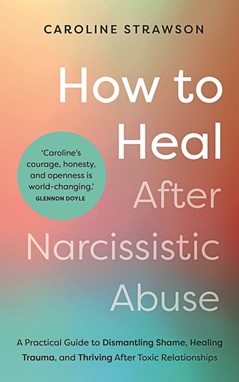
Caroline Strawson is a globally recognised mental health and nervous system educator and therapist, and also the author of How To Heal After Narcissistic Abuse. Her No Visible Bruises campaign is designed to educate police forces and GPs about the physiological signs of domestic abuse. Find out more at carolinestrawson.com.