

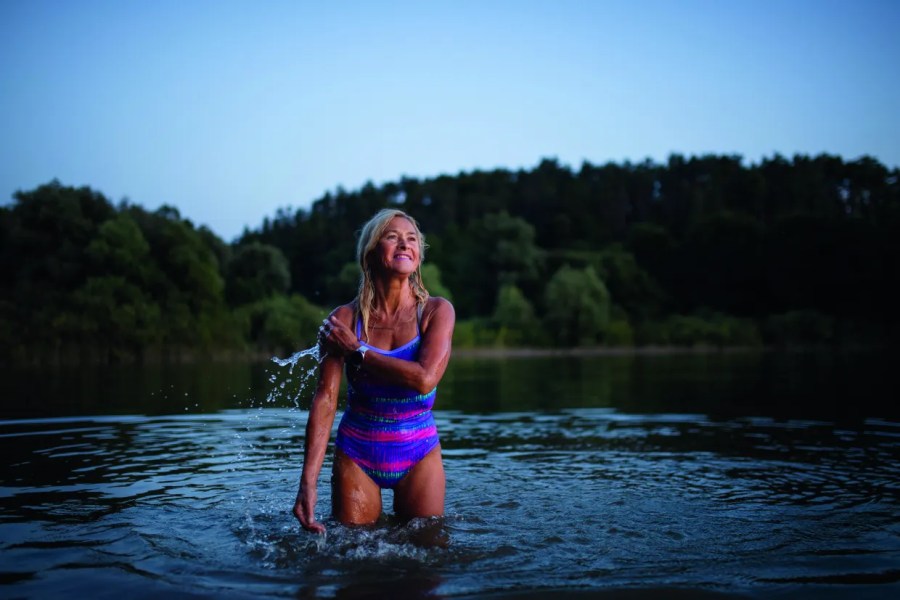
Dr Susanna Søberg, author of Wild Swimming, shares why swimming for fat loss can help you lose weight and improve your metabolism by activating your brown fat
Words: Dr Susannna Søberg | Images: maclehose press & Shutterstock
We’re born with brown fat and newborns have, relatively speaking, quite a bit of brown fat between the shoulder blades.
Until 15 or 20 years ago, brown fat was thought to be insignificant in adults. It was also believed that the tissue disappeared as a person got older, until the 1970s when it was discovered during PET/CT scanning of adults. The largest deposits detected were around the neck (collarbone) and along the spine, while smaller deposits were noticed around the heart and kidneys.
The amount of brown fat in adults is difficult to determine, but it is estimated to be 200-1,500 grams (7-53 ounces), while some adults have none left or never had any in the first place. Studies have shown that brown fat decreases with age, and we need to activate it to keep it.
Most healthy, normal-weight adults under the age of 40 still have deposits of brown fat, but after the age of 40, many functions in the body change noticeably – first and foremost our ability to burn energy diminishes. Many people notice that the usual run isn’t enough to keep off the weight. We may have less time to invest in exercise and our health.
Research has shown that people with diabetes and obesity are most likely not to have much brown fat left – and many have none. It is also possible that the disappearance of brown fat is a reason for weight gain and a slowing metabolism. This is probably a chicken-and-egg situation.
But every rule has exceptions. I have noted in my own experiments that some adults over 40 do have brown fat, including those who are both overweight and have diabetes. We don’t know the reasons for this, or how it develops differently.
Theories, however, point to contexts such as genetics, lifestyle and environment. If you spend a lot of time outdoors in cold temperatures, in changing weather conditions or you live in a cold country, then you probably have a higher chance of retaining brown fat through adulthood. Consistent activation of brown fat is probably needed to maintain it.
Improving your insulin sensitivity
There have been several studies on rodents and humans that have provided evidence that the cold activates brown fat and creates more of the tissue, increases energy metabolism and improves insulin sensitivity and blood-sugar balance.
In one study of middle-aged women who swam in cold water for an entire season, an increased sensitivity to insulin was found, which could mean that cold water has long-term effects on balancing blood sugar. The study did not determine whether the improvements were related to brown fat, but in their report the researchers raised the question of whether brown fat may be the cause.
Another study examined the effect of continuous cold room temperatures on brown-fat activity and the amount of brown fat, to explore whether people develop more brown fat by sleeping in cool rooms. After four months, it was determined that sleeping in a colder room of 19°C (66°F) led to an increase in brown fat in participants, while sleeping in a room at 27°C (80°F) led to the almost disappearance of brown fat. The study thus confirms that persistent exposure to cold can help to create greater quantities of brown fat and improve insulin sensitivity.
There was also a study of subjects with diabetes or obesity equipped with cooling vests at a temperature of 14-15°C (59-60°F), which they wore for 10 days. A before-and-after FDG-PET/CT scan revealed that they all showed an increase in their brown fat. They also had improved cellular insulin sensitivity.
In a further study, subjects each sat by an open window for half an hour for 20 consecutive days; they too showed an increase in brown fat. Each of these studies used different cooling methods, but all show an improvement in insulin sensitivity, which can potentially regulate blood-sugar balance. It is not known, however, to what extent the improvements are due to muscle versus brown-fat activity.
Your in-built “calorie eater”
First, brown fat burns sugar and fat from the bloodstream, which will then release lipids from white fat stores and sugar from liver and muscle stores. Unlike white fat, brown fat is activated incredibly quickly when exposed to the cold and burns energy straightaway. Studies have found that if you put a hand or a foot in a bucket of iced water, you’ll activate brown fat in seconds or minutes, and this is detectable on PET/CT scans. This is not the case with white fat, unfortunately.
It is exciting that we are able to influence the amount of brown fat we store in our bodies, and thereby affect our health. Think about it as having an internal wood-burning stove that burns energy even when you’re not running or exercising – and even when you’re not cold. Brown fat is an extra “calorie eater” that contributes to the bottom line when it comes to energy expenditure.
Reasons to swim
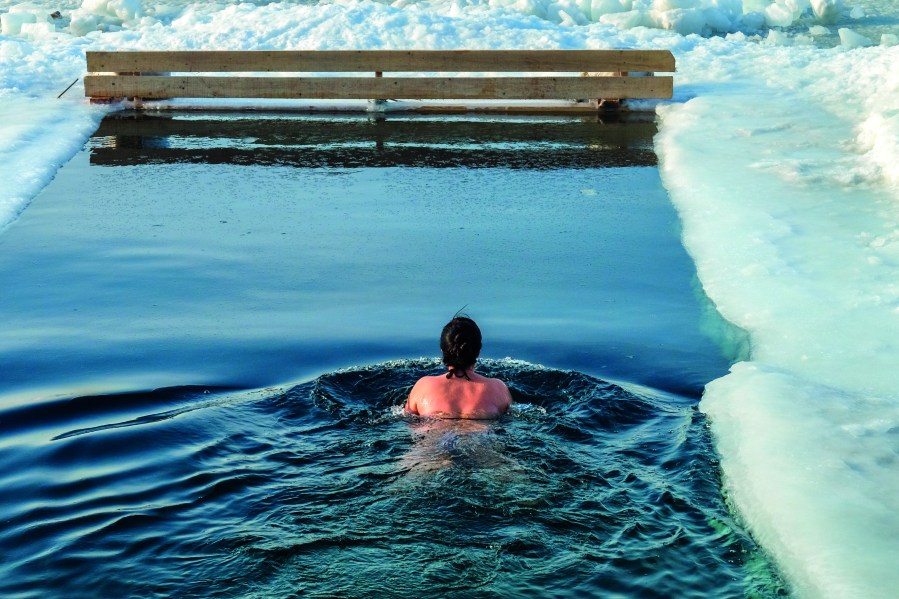
If you can generate more brown fat from sleeping in the cold or wearing cooling vests, it’s conceivable that regular winter swimming would increase the amount of this tissue in your body to an even greater extent. This could be attributable to both behavioural and physiological things:
- The direct positive effect of cold water, which stimulates a cascade of neurotransmitters and hormones, motivating people to swim again and again for the pure thrill of it.
- It gets people moving and out into the cold, which activates the sympathetic nervous system. When you immerse yourself in cold water, noradrenalin rises dramatically. The level drops quickly when you get out of the water. Studies have shown that the sudden and intense cooling of the skin accounts for the dramatic increase in noradrenalin, which activates the brown fat.
We still know too little about how much brown fat humans have and how many calories are burned during cooling, even after a brief plunge in the water. It would be interesting to measure the long-term effects of winter swimming on brown fat for a full season, and, in fact, this is the subject of my PhD studies.