


With the recent film adaptation of Freida McFadden’s bestselling book The Housemaid, we look at coercive control in relationships and how to spot the signs.
Images: Pexels
This article contains spoilers as well as discussions of domestic abuse
It sold over 4.5 million copies worldwide and took BookTok by storm — now Sydney Sweeney will be starring as the titular housemaid in the upcoming box-office adaptation.
But why does The Housemaid have us hooked, and can we learn from its portrayal of coercive control in relationships?
The book begins with protagonist Millie Calloway interviewing for a job at the house of wealthy Nina Winchester and her husband, Andrew. Millie, an ex-con who is living in her car, is desperate for work and is happy to overlook any red flags in exchange for a room in the Winchesters’ gorgeous estate.
And the red flags come thick and fast – no sooner has she been hired by seemingly sweet Nina, than things start to turn nasty and uncomfortable. Millie is repeatedly given conflicting information, made to feel unwelcome, chastised and shouted at by her employer.
Things start to come to a head when she notices the presence of anti-psychotics in Nina’s bathroom cupboard and hears rumours from Nina’s supposed ‘friends’ about her mental breakdowns, psychotic episodes and repeated institutionalisations; all the while, Nina’s handsome husband Andrew appears in contrast as the perfect man.
But this is far from reality, as Millie later discovers. In actuality, Nina is a survivor of coercive control and abuse at the hands of her manipulative and sadistic husband — and with this discovery, we learn just how wrong we have all been about Andrew Winchester.

What is coercive control?
Women’s Aid, the national charity working to end domestic abuse, tells us that domestic abuse is not always physical — in fact, it can be completely invisible.
‘Coercive control creates invisible chains and a sense of fear that pervades all elements of a survivor’s life’, reads their website. ‘It works to limit their human rights by depriving them of their liberty and reducing their ability for action.’
Essentially, coercive control can be a whole host of manipulative, controlling and dehumanising behaviours, designed to steadily strip the victim of their own agency.
Sadly, it’s not an uncommon story – in the year ending March 2025, Women’s Aid reports that there were 49,557 offences of coercive control recorded by the police in England and Wales, an increase from 45,310 in the previous year.
So, what is coercive control, and how can we recognise the signs?
The government defines it as a type of domestic abuse, in which the abuser ‘uses violence, threats, puts them down or scares and frightens the victim. They do this so they can control the victim and make them do things they don’t want to.’ It has been a criminal offence in the UK since 2015.
Some common examples of coercive behaviour include isolating you from friends and family, depriving you of basic needs such as food, monitoring your activity, humiliating or degrading you, controlling finances, threatening you, and much more.
In The Housemaid, we learn that Nina’s supposed-psychotic episodes and her stays in Clearview Psychiatric Hospital are all orchestrated by Andrew as a way to undermine her, making any attempts to tell the truth about his behaviour more than difficult.
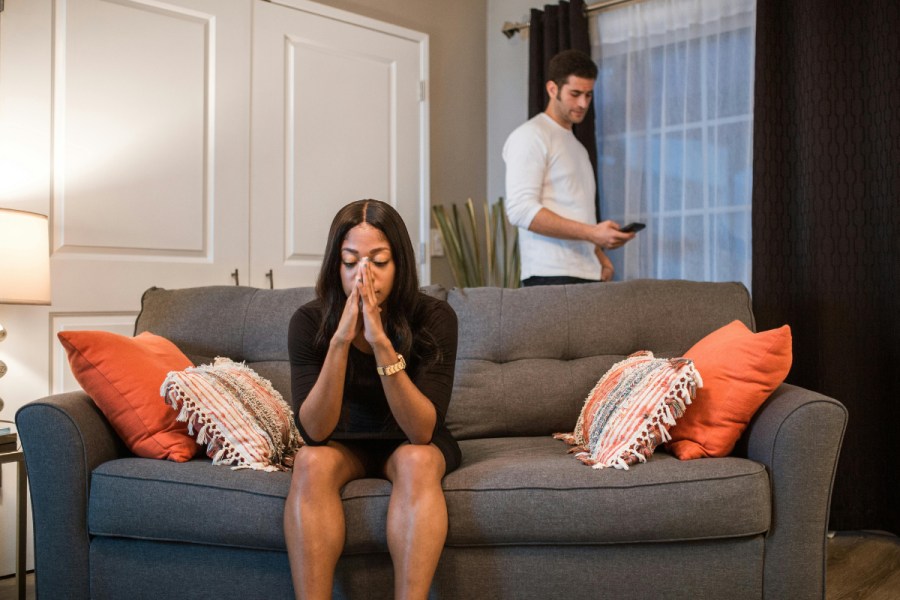
This is just one of the many ways he exerts control over her, including keeping her locked in an attic room and refusing to give her food and water, forcing her to pull out her own hair, and threatening and endangering her child, Cecilia.
But we learn that Andrew did not always appear so sadistic – in fact, at first, he made himself out to be the perfect gentleman.
Hidden signs of coercive control
Speaking to Top Santé earlier this year, mental health and trauma coach Caroline Strawson says that one of the earliest red flags of coercive control is the ‘overwhelming intensity of the connection’ you might feel from your partner in the beginning.
‘Very often, this “love bombing” is not about love, it is about creating rapid emotional dependence without allowing time for genuine trust to form,’ says Caroline.
‘What once looked like care becomes criticism. What felt like protection now feels like surveillance. The way you dress, the people you speak to, how often you go out, all of it begins to feel scrutinised. You may start making choices not because you want to but because you are trying to avoid a reaction.’
If this sounds familiar, or if something is starting to not feel quite right in your relationship, it could be a sign you might be dealing with coercive control.
Another warning sign is if you find your own behaviour has changed due to the way you’re treated – for example, if you find yourself avoiding certain behaviours out of fear of the reaction they’ll garner from your partner.

What to do if you think you may be in an unhealthy relationship
First of all, it’s important to know that if this all sounds too familiar to you, you are not at fault. The actions of an abuser are not reflective of your own behaviour, and healthy relationships should feel loving and safe — and should never make you feel trapped and isolated.
Women’s Aid has a variety of resources available, whether you’re just becoming suspicious, you want to leave the relationship but you’re unsure how, or you’ve already left and require resources to overcome what happened to you. You can access them in the Survivor’s Handbook.
You can also call Refuge’s National Domestic Abuse Helpline in the UK on 0808 2000 247, or visit their website.
The Housemaid, directed by Paul Feig and starring Sydney Sweeney and Amanda Seyfried, has been in cinemas nationwide from December 26th 2025