


Magnesium is an essential dietary mineral that is integral for your overall health and wellbeing. Yet, most of us are not getting enough. Here’s what you need to know.
Words: Eva Gizowska. Images: Shutterstock, Pexels.
When it comes to nutrients, magnesium really is in a league of its own. It’s a powerhouse that is involved in more than 300 bodily functions. ‘Magnesium is crucial for energy production, healthy muscle, nerve and immune function, blood pressure regulation and blood pressure control,’ says nutritionist Will Jordan. ‘It also plays an important role in keeping bones healthy, helping to regulate hormones, mood and sleep, and supporting the cardiovascular system.’ Your body can’t make magnesium, so if you want to stay healthy, you need to get it through diet, or by taking additional supplements.
‘Making sure you get enough magnesium through diet can be quite difficult,’ says Will. ‘Poor farming practices, depleted soil, high intakes of ultra-processed foods, and the modern Western diet generally mean that many people are simply not meeting these nutritional requirements.’ Current national guidelines recommend that women need to consume 270mg magnesium, and men need 300mg daily. But data from the government’s UK National Diet and Nutrition Survey, 2024, shows that around 50 per cent of adult women and about 20-25 per cent of adult men have a magnesium intake below the recommended levels.
These figures are echoed in a new nationwide survey of more than 2,000 people conducted by Viridian Nutrition, who have also published a White Paper on magnesium, which shows that nearly three quarters (73 per cent) don’t supplement regularly or frequently with magnesium – yet they could benefit. The results also reveal a worrying lack of nutritional awareness. The survey found that while one in three (35 per cent) admitted they sometimes include foods in their diet to increase magnesium, two-fifths (42 per cent) said they rarely or never include foods specifically to increase this mineral.
Mighty Mineral
The Viridian survey also highlighted many misunderstandings about the health benefits of magnesium. While 34 per cent reported taking magnesium to improve sleep, and a quarter (25 per cent ) recognised that the mineral was beneficial for muscle and nerve function, 28 per cent admitted that they were unclear on magnesium’s exact role in the body.
‘Magnesium does far more than support muscles and sleep,’ says Aimee Benbow, nutrition director at Viridian Nutrition. ‘It also plays a role in many aspects of health from healthy bones and regulating hormones to improving insulin sensitivity and reducing inflammation. This essential mineral is vital for overall wellbeing.
‘Magnesium insufficiency is a common yet overlooked health issue in the UK and worldwide. It is linked to a range of chronic diseases, including heart disease, diabetes and migraines. Certain groups, such as older adults, athletes, and those with digestive disorders, are particularly at risk. Addressing magnesium insufficiency could improve health outcomes for many,’ she explains.

8 REASONS YOU NEED MAGNESIUM
1. To Give You Energy
There’s a reason magnesium is often dubbed the “spark of life” because we need it for energy. ‘Magnesium creates energy by activating the enzyme ATP synthase, which is responsible for the formation of adenosine triphosphate (ATP), the energy currency of the body,’ says Will.
ATP is necessary for all bodily processes from digestion to immune function and is made by the body as and when it needs it. When ATP is low, this is also reflected in your physical energy levels. The body can only store small amounts of ATP, so your body needs to produce a continuous supply for energy.
2. For Healthy Bones
Magnesium plays a crucial role in bone health, influencing bone density and strength. A deficiency can lead to weakened bones and an increased risk of fractures. Hip fractures currently account for 75,000 hospital admissions annually in the UK. Could some of these fractures be caused by magnesium deficiency?
In a recent meta-analysis (Nutrients, March, 2023) which involved 119,755 participants (average age 62, 33 per cent women, who were followed up for 79 months), the findings suggest that patients with low serum magnesium concentrations had a significantly higher incidence of fractures. Magnesium also keeps calcium in check.
‘You want calcium to be directed to your bones and teeth, not into soft tissues as calcium crystals,’ says Dr Carolyn Dean, author of Magnesium: The Missing Link To Total Health (£7.99, Bluestone). ‘Magnesium not only dissolves calcification, but along with vitamin K2, it also directs calcium to your bones and teeth.’

3. To Reduce Muscle Cramps
Magnesium is involved in the relaxation of smooth muscle, including the stomach, intestines and bladder. Muscle cramps are thought to be caused by dehydration, mineral imbalance, and tired muscles. ‘All muscle cells contain more magnesium than calcium,’ says Dr Dean.
‘Magnesium controls calcium channels that allow only a certain amount of calcium to enter cells. If magnesium is deficient and there is too much calcium, this can cause muscle spasms.’ Magnesium supplementation has been found to significantly reduce the duration and intensity of muscle pain caused by cramps.
In a recent study (Nutrition Journal, 2021) on 175 people, it was shown that taking 260mg magnesium capsules at bedtime, for 60 days, significantly reduced nocturnal leg cramps.
4. To Regulate Hormones
Latest research shows that magnesium can help to regulate sex hormone production, and taking supplements may help to reduce the symptoms of PMS, including anxiety, depression, bloating, tiredness and headaches.
‘A recent review (Nutrition & Food Science Journal, 2021) has shown that magnesium levels are lower in women with PMS than those with no symptoms,’ says registered nutritionist Rob Hobson.
‘The review also found that supplementing with magnesium has been shown to significantly reduce PMS symptoms such as fluid retention, weight gain, bloating, anxiety and breast pain. Magnesium works with vitamin B6 to reduce the effects of excess oestrogen, which can trigger or make PMS symptoms worse. It also acts as a muscle relaxant and can help to reduce period pain.’ For extra PMS support, take magnesium with vitamin B6 and saffron extract.

5. To Keep Your Heart Healthy
If you’re low in magnesium, this may raise your risk of cardiovascular disease. A recent meta-analysis (Journal Of The American Heart Association, 2023) on 42,711 people, 5,051 with cardiovascular disease (CVD), indicates that magnesium depletion is a vital risk factor associated with CVD. Studies show those with higher magnesium intakes have a reduced risk of coronary heart disease, stroke, heart attack and high blood pressure.
‘Magnesium supplementation acts similar to calcium channel blockers,’ says Will. ‘It increases nitric oxide and dilation of the blood vessels, improving blood flow, which is beneficial for cardiovascular health.’ For extra support pair magnesium with hawthorn extract.
6. To Keep Blood Sugar Levels Balanced
Latest research suggests that magnesium helps to keep blood sugar levels balanced. Magnesium is needed to help your body convert glucose from food into fuel. Insulin resistance is where the cells have an impaired response to insulin, the hormone that signals glucose uptake, resulting in elevated blood sugar levels.
So, if you are not getting enough magnesium, cell response to insulin can become compromised, preventing glucose entering the cells which in turn will impact energy levels.
‘Low magnesium levels in the body have been associated with higher fasting blood glucose levels which can lead to metabolic disease and raise your risk of type 2 diabetes,’ says Will. ‘Other nutrients that can support blood sugar levels include cinnamon, chromium and alpha lipoic acid.’

7. To Reduce Stress and Boost Mood
Known as nature’s tranquilliser, magnesium has a naturally calming effect. ‘Magnesium causes muscles to relax, it helps to regulate heart rate, lowers blood pressure and stimulates levels of the calming neurotransmitter, GABA (gamma-aminobutyric acid) in the brain,’ says Rob Hobson, author of The Art Of Sleeping (£9.99, HQ).
‘This helps to calm nervous tension and relax the mind. When you’re stressed your body uses magnesium, and also vitamins B and C, more quickly.
8. For Better Sleep
Taking a magnesium supplement at bedtime can also be very beneficial if you’re experiencing sleep problems. Research suggests that magnesium supplementation may improve several aspects of sleep, including quality and duration.
In a recent US study (European Society Of Medicine, 2024) it was shown that magnesium may be an effective nonpharmacological intervention to promote better sleep.
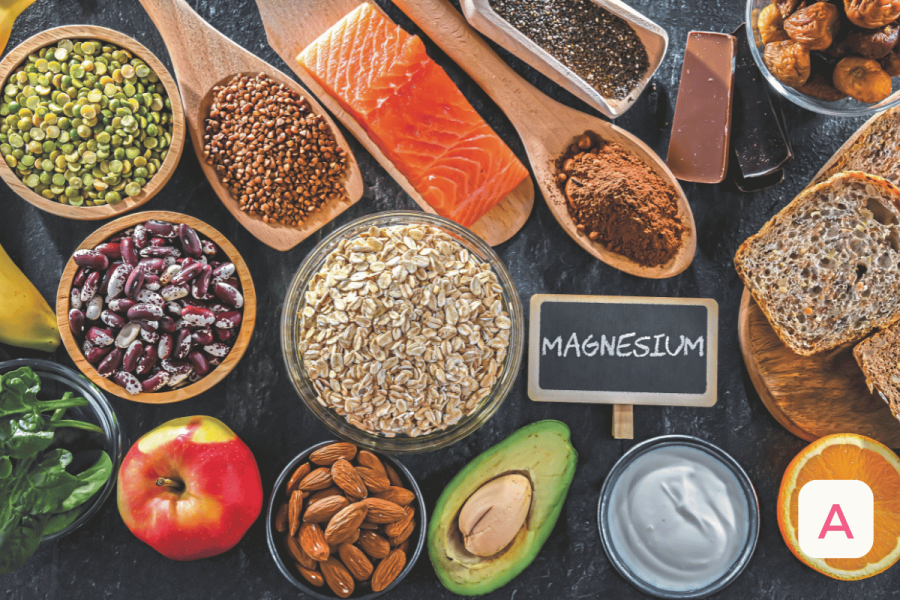
Magnesium-Rich Foods (mg/100g) to include in your diet
- Sunflower seeds 390mg
- Sesame seeds 370mg
- Poppy seeds 330mg
- Brazil nuts (no shell) 410mg
- Almonds 270mg
- Cashews 270mg
- Peanuts (no shell) 210mg
- Bran wheat 389 mg
- Quinoa (raw) 210mg
- Brown rice (boiled) 49mg
- Banana 27mg
- Avocado 25mg
- Green beans 254mg
- Edamame (boiled) 65mg
- Pinto beans (boiled) 56mg
- Chickpeas (boiled) 44mg
- Kidney beans (boiled) 40mg
- Baby spinach (boiled) 112mg
- Rocket (raw) 28mg
- Peas (boiled) 27mg
- Sardines (canned) 42mg
- Tuna (baked) 41mg
- Salmon (smoked) 31mg
- Cod (grilled) 30mg
- Dark chocolate 89mg
Choosing the right supplement
It’s not always realistic to meet your daily magnesium requirements through diet alone. This is where taking a supplement can be helpful. But, with so many different supplements on the market, choosing the right one for you can be confusing.
‘There is no one-size-fits all magnesium,’ says nutritionist Phil Beard. ‘Some people benefit from a specific form, while others may need a blend.’ Also, whether you opt for a capsule, liquid or powder format, is all down to preference. Capsules provide the most consistent dosage, but liquid or powdered formats can be added to cold drinks, which may be more suitable for some people.’
Chelated magnesium
When supplements have been chelated, it means the mineral has been bound to another compound. These may provide additional benefits. For example:
- Magnesium citrate is formed by chelating magnesium to citric acid, which is highly water soluble and can be absorbed very quickly in deficiency states. • Magnesium bisglycinate contains magnesium and the amino acid glycine, both of which have been found to support sleep, and this combination is also gentle on the digestive tract.
- Magnesium oxide is chelated to oxygen. This is a less water-soluble form which means it stays in the gut for longer allowing for a slow but steady supply.
- Magnesium ascorbate is bound to vitamin C (ascorbic acid) which provides additional benefits to the immune system.
- Other forms include: magnesium carbonate (chelated to carbon), magnesium malate (chelated to malic acid), magnesium sulphate (chelated to sulphur), magnesium chloride (chelated to chlorine), magnesium taurate (chelated to taurine).
Ionic magnesium
If you’re not sure which magnesium supplement is right for you, consider ionic magnesium. ‘Ionic magnesium is easier for the body to absorb and utilise, as it’s not bound to any other compound,’ says Phil.

Top Tips
Nutritionist Phil Beard recommends:
- Always choose a magnesium supplement that is either earth-sourced, pure and fully chelated, or in ionic unbound form and contains 100 per cent active ingredients. This will provide the highest natural potency without any fillers, binders, glues, irradiation or lubricants.
- Explore different types and doses. Finding a supplement that’s right for you may be a case of trial and error. No form is superior to another as people supplement with magnesium for different requirements, therefore the dosage of magnesium is more important than the form or format.
- Always start at a lower dose and build up slowly.
- You can optimise the effects, depending on when you take a supplement. For example, magnesium taken with dinner, or a couple of hours before bedtime may help to improve sleep.
- Magnesium works very well on its own, but paired with other supplements it can offer additional benefits.
- Trial a supplement consistently for at least 30 days, to assess its effectiveness before switching to a different type.

Try it: Viridian Ionic Magnesium Liquid, £24.70 for 100ml, viridian-nutrition.com. This contains 100 per cent active ingredients, with no artificial fillers or nasties, and is sourced from the pristine northern shore of Great Salt Lake, Utah, which ensures a clean and natural environment.
It is left untouched for a further two years to allow natural evaporation of sodium, leaving a concentrated form of liquid magnesium. The term ionic confirms the magnesium is ‘unbound’, and therefore ready to react, allowing for quicker absorption and higher bioavailability, making it more effective for psychological function, energy metabolism, and reducing fatigue.