
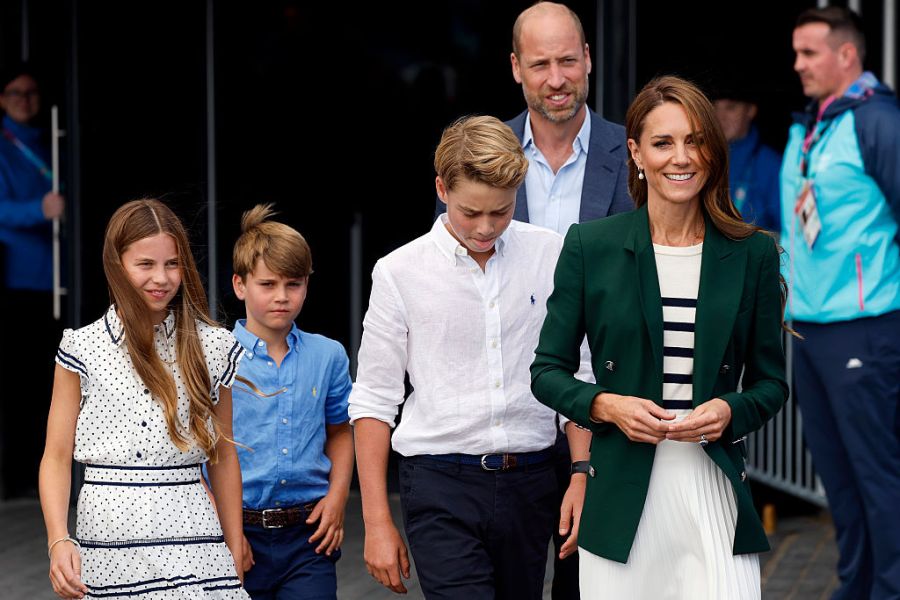
With King Charles’ diagnosis prompting a step back from public appearances and Princess Kate gradually returning to royal duty, the next generation of working royals have much more streamlined priorities. So, as questions rise on the importance of a royal presence, what will be the challenges facing the next generation of British royals in modern Britain?
Words: Amy Dowrick | Images: Getty
This summer saw protests at Trooping the Colour – something that hasn’t traditionally been seen before. The royal family were met with booing during the procession before the event – and they had also experienced this just a few months prior when going into Westminster Abbey at a Commonwealth Day event. But while there have always been protests, what makes them so prevalent now?
“I think it’s a good thing, because many of us are a bit divided,” says historian Andrew Wilson. “On the one hand, we can see lots of arguments asking why one family should, most of whose social private wealth actually derives from public sources, be singled out as these examples to the rest of us. Why can’t we be sensible like other countries and have an elected head of state?”
“On the other hand, I do think the royal family connects us with our shared past,” he adds. “This is one thing that unites us, and while I think it’s a perfectly reasonable thing if you’re a republican to stand in the street and shout, at the same time it’s perfectly reasonable for others – who’ve had all these doubts ourselves – to answer back. One way to answer back is with rituals.”
Challenges facing the next generation of British royals in modern Britain
Pageantry
The British monarchy comes with a lot of pomp and pageantry. We’ve seen Trooping the Colour and Royal Ascot in the summer months and will see gun salutes, uniforms and carriage processions throughout the year – but what place does it hold in modern Britain?
At a time of protest, scrutiny and tough questions about the monarchy’s value, many argue whether these grand displays feel out of touch, and whether it is an image that the public want to see projected.
“At a time when many of us are struggling, it’s a good question,” says Andrew. “I think what the royal family has to do is to come to grips with their own personal wealth, how it’s used and how much they’re getting freebies.”
“We have a right to ask why they consider themselves entitled – not merely as individuals, but as the receivers of a great deal of public benefaction and money,” he adds. “I think that’s something that evidently Prince William is trying to sort out in selling off bits of the Duchy of Cornwall and give the money to good causes.”
But according to Andrew, as much as the institution will need to meet a modern Britain in the future, its rituals and spectacles more than likely aren’t going anywhere – and shouldn’t.
“Just look around at our divided, broken country,” he says. “Every country needs something that is going to try to hold together a fragmented society.”
“To have an institution, which seriously takes the idea that we truly are a united society, the royal family has been incredibly good at emphasising that fact.”
“In terms of public expenditure, it’s nothing to the money that politicians waste day in day out,” he adds. “The King is far more popular, both as a person and as a figure, than any political figure – he has 70-75% approval ratings.”
“It’s an affirming thing. We need rituals – a bit of mumbo jumbo doesn’t do anybody any harm.”
A streamlined public face
The King has said that he wants the monarchy to be good value for money – but what we’re now seeing is fewer senior working members of the royal family. Will they have to work harder to justify the institution to the public?
“It’s deliberately streamlined because King Charles (when he was the Prince of Wales) made it clear that it was getting out of hand,” says Andrew. “And from their point of view, the wider reaches of the royal family are perfectly normal people, and don’t necessarily want to do royal duties.”
“The key word is relevance,” adds former SAS soldier Jamie Lowther-Pinkerton, who was the first private secretary to a young Prince William and Harry. “To my mind, people like the Duke and Duchess of Gloucester, the Kents, and particularly the Princess royal cover the national landscape and the national psyche. The work ethic that they put into this has been an incredibly important part of it, which is touching the whole national psyche.”
“This diaspora royal family really roaring around the country is doing the monarchs bidding – if you have that base, then you can start to adopt the Tudor model, which is picking the moment to really get out there and make an impact.”
But while Jamie has seen the monarchy across generations, and very few people understand what it takes to be a modern royal better than him, even he has concerns for the future.
“My worry is the ability to do that with quite a narrow base. The relevance is promulgated in quite a major degree by the huge work ethic of a wider royal family. “I worry just for the effort of the individuals concerned as well as the monarchy itself because they’ll be so busy and too stretched,” he adds.
“Having said that, I know that a lot of thought has gone into this – and I think we’ll be surprised at how they’ll deal with it. There’s a lot of innovative minds looking at this, so I don’t think my worries should be something I don’t sleep over.”