
Sandra Parsons, author of Age Less, shares the simple tests you can do at home to assess your level of mobility, flexibility and strength – all of which determine your longevity potential – and the moves to help improve your scores.
Words: Sandra Parsons. Images: Shutterstock and Lezli+rose for Sandra Parsons’ picture.
In these before-and-after tests, you are looking at how much you improve rather than whether or not you match up to some standard of how you “should” do. When you are fitter, you can compare yourself to national averages.
Don’t forget to write down your test results so you can compare them four weeks later. If you find them easy, great! If you find them challenging, please don’t worry.
Do the strength moves shown here for 2-3 weeks and then test yourself again. You’ll be amazed, encouraged and motivated by how quickly your results change, and by how soon your mood and energy improve. The moves can be done at home and require no equipment other than a chair, a firm cushion or yoga block, and two normal-sized cans of food or two small bottles of water (to be used as weights).
Read more about how Sandra reduced her biological age from 60 to 20 here.
Normal ranges
Sit-to-stand test: 14-19 stand-up and sit-downs.
Chair sit and reach: measurement between toes and fingertips when foot is at 90 degrees – 1-4in.
Back scratch test: hands 2.5-10in apart.
Arm curl test: 12-17 arm raises in 30 seconds.
Make a note of your scores then test again in a few weeks after you’ve done the workout circuit each day.
Sit-to-stand test
This measures how strong your “motion” muscles are (gluteals, hamstrings and quadriceps). Place a dining chair with no arms next to a wall. Sit down with one foot slightly in front of the other to help stability. Cross your arms in front at your chest. Count how many times you can stand up and sit down again in 30 seconds.
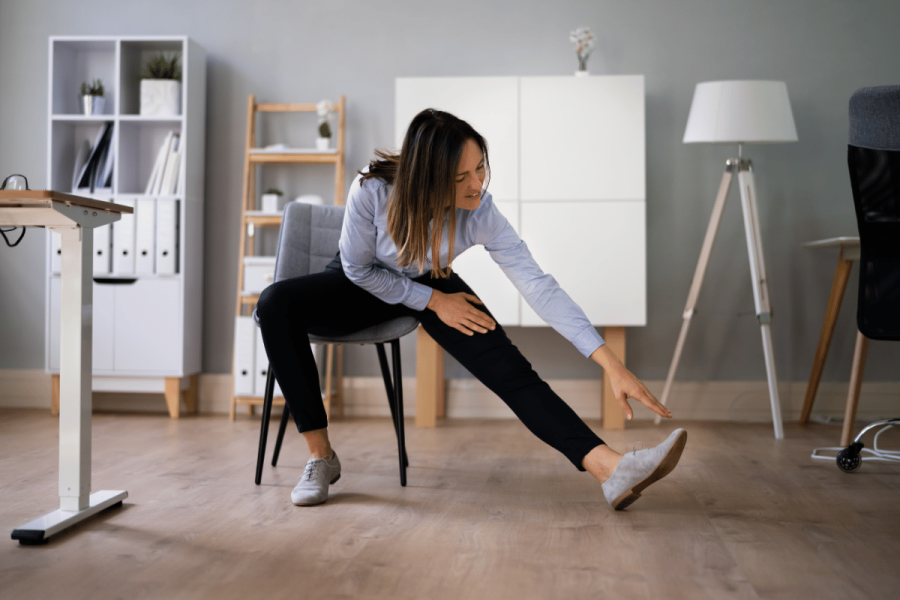
Chair sit and reach
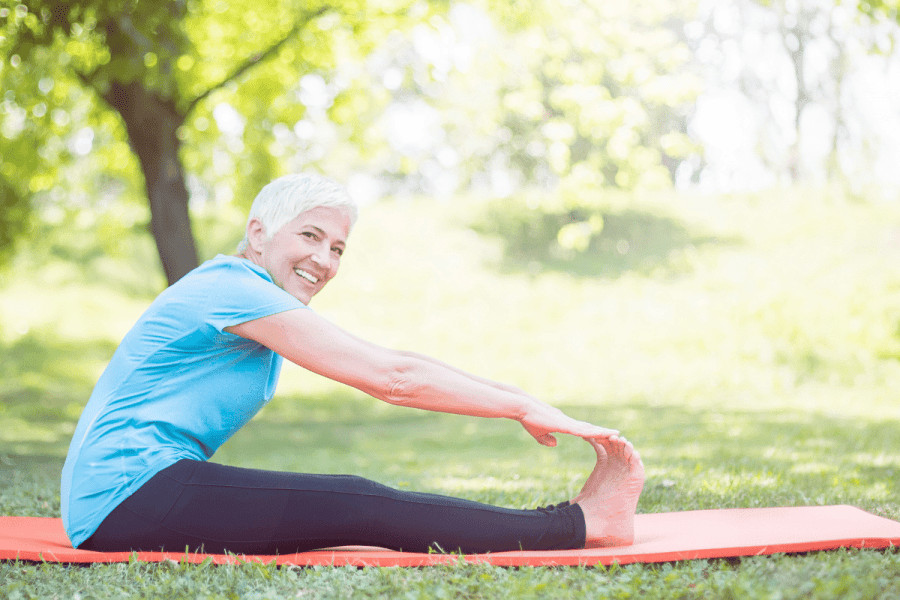
This measures lower-body flexibility. Sit on a dining chair with one leg bent and the other straight out in front of you with the heel on the floor. Reach down the straight leg to your foot and measure how far your fingers go.
Back scratch test
This measures upper-body flexibility. Stand upright. Stretch one hand back over your shoulder and down your back. With your other hand, reach round to the back from below. Can your hands meet? Check in a mirror how far apart they are. Do this on both sides.
Arm curl test
Sit on a dining chair and hold something such as a 500ml bottle of water in each hand or, if that is too heavy, a 400g tin of beans. Keeping your back straight and against the chair, raise and lower the weights as many times as you can in 30 seconds.
Move your arms from completely straight to as bent as your body allows.
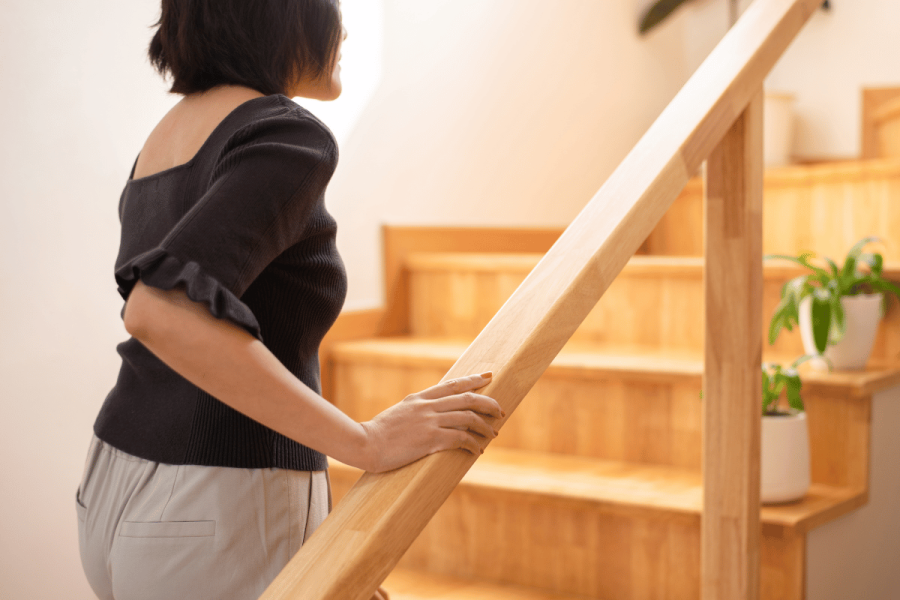
Walking upstairs
A functional movement that tests gait, lower-body strength, balance, core strength and muscle endurance. This test is subjective.
Walk up a flight of steps in your house, then turn and walk down again. Ask yourself these questions as you are doing it (and don’t do anything that makes you feel unsafe): Am I standing upright as I walk up these stairs or am I bent forward? If so, by how much am I bent forward?
This demonstrates lower body strength. Do I automatically hold the stair rail to help me? Am I using it to push against to help me up or do I use it for balance? This demonstrates balance and strength.
How many steps can I do before I am breathing heavily? This demonstrates cardiovascular strength. What am I doing to help myself get down the stairs safely? Do I twist towards the rail?
This demonstrates balance. If I consciously try to walk up a few stairs upright without holding the rail, how many stairs can I do?
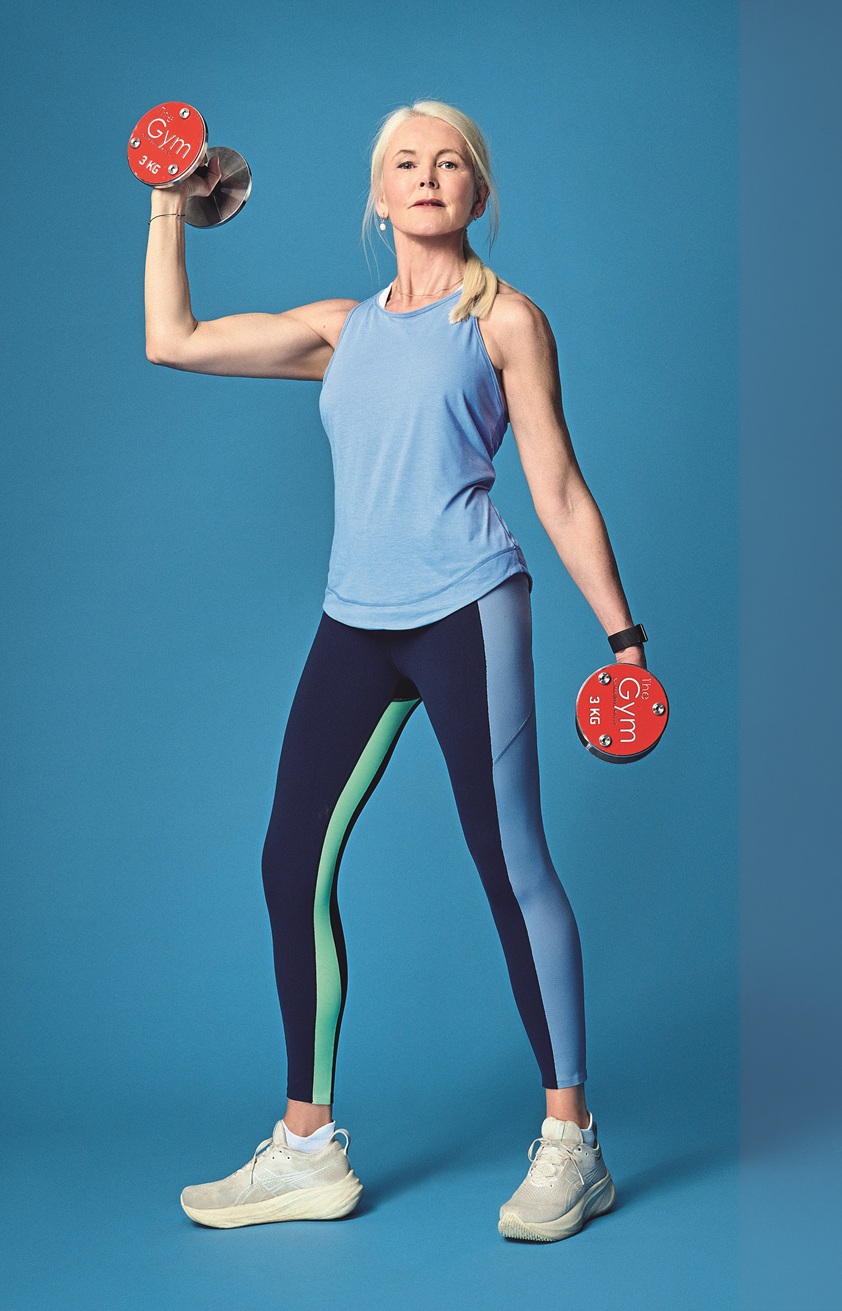
WARM-UP MOVES
High knees
Inhale and bring your right knee as high up to your chest as possible. If you want, put your left hand on a wall for balance and support. Use your right arm to hug the knee closer as you begin to exhale, then keep exhaling as you lower the leg to the ground. Do this a few times, then do the same thing with your left leg (turning round if you want so that you can put your right hand on the wall).
Jumping jacks
Stand with your feet slightly apart. Jump on the spot, swinging both arms above your head as you rise, and bringing them back down by your sides as you land.
Hip rotations
With your left hand on the wall, lift and bend your right knee and point your toes. Move your knee slightly forward and then rotate it out to the right, down and back, activating your right hip as you form a small circle. Point your toes as you bring your foot down, flex your foot as you bring it back up. Do this five times, then reverse the direction and do it five more times. Turn around and, with your right hand on the wall, go through the same movement with the left leg.
Leg swings
With your left hand on the wall, swing your right leg slowly forward and back eight times, keeping it straight. Then swing it out to the right eight times. Then, with your right hand on the wall, do the same on the other side. Keep your hand on the wall for balance.
Plank
Lie flat on the floor on your stomach. Come up on to your elbows, with your forearms straight in front of you on the floor, palms down. Keep your legs straight and your feet flexed, so that your toes are touching the floor and the soles of your feet are facing straight out behind you. Engage your muscles – stomach, legs, glutes (buttocks) – and keep your back straight so that your bottom is tucked in rather than sticking up in the air. Remember to breathe!
Arm windmills
Windmill your arms up in front of you, over your head, then out to the sides as you bring them back down, and repeat this movement eight times. Repeat in the opposite direction.
Arm swings
With your feet firmly planted on the ground and with your knees very slightly bent, keep your hips facing forward as you swing your arms up and over to the left, so that your right arm comes across your chest. Do this eight times, then switch direction. Don’t go too fast or be too vigorous – this is quite a powerful exercise, especially if you do not have much upper-body mobility. Less is more at the beginning.
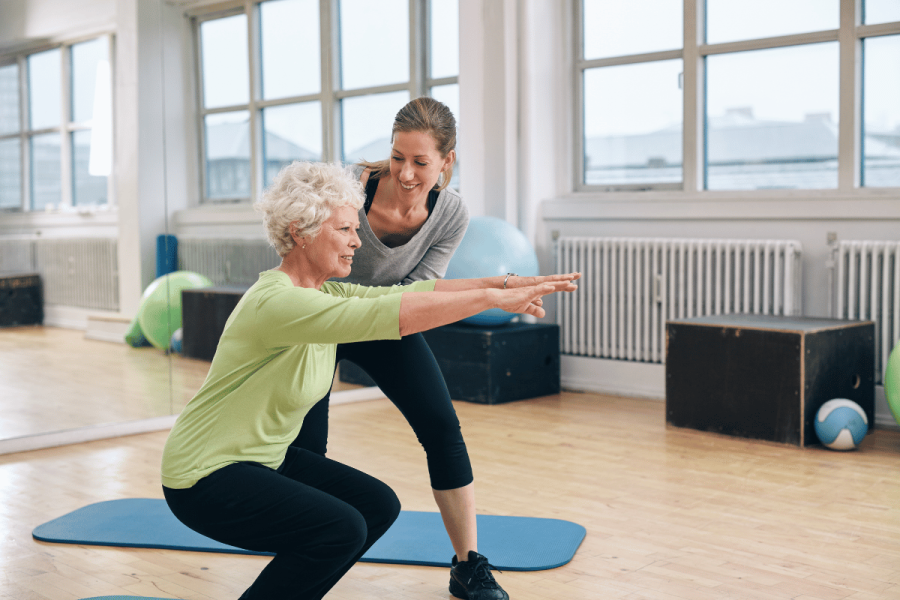
STRENGTH EXERCISES
Squat
Stand with your feet slightly wider than shoulder width apart, inhale, engage your core muscles and keep them engaged as you bend your knees and go down into a squat. Think about keeping as much weight as possible in your heels. When you’ve gone down as far as you can – imagine you are sitting on a chair – push down hard with your heels, keep your core engaged and slowly come back up, exhaling.
Kneeling press-up
Kneel on the floor and, keeping your feet flexed behind you, hinge forward to put your hands on the ground in front of you. Your arms should be straight, and your hands should be positioned directly beneath your shoulders. Lift your feet slightly and cross them at your ankles – you should now have only your knees and hands in contact with the floor. Keeping your spine long and without arching, look straight ahead and bend both your arms to lower your chest towards the floor. Then push back up to the starting position. If this is too much, do a wall press-up instead.
Wall press-up
Place your hands on the wall in front of you and move your feet back just far enough for your arms to be parallel to the floor and at shoulder height. Then bend at the elbows, looking straight ahead, keeping your spine long and without rounding your back, and bring your chest closer to the wall. Push back up into the starting position. The lower your hands and the further away your feet, the more difficult the exercise.
Plank with shoulder taps
Begin on your hands and knees with your elbows straight and hands on the floor shoulder-width apart. Reach each foot back one at a time to form a “plank”. You should have your core engaged and your back as straight as possible.
Now lift your right hand off the floor and tap your left shoulder. Return your right hand to the floor and do the same with your left. Then repeat the tapping. If holding the plank is too much for you, stand up and, facing a wall, do the exercise in a wall press-up.
Lunge
If you are not used to doing lunges, start by doing them alongside a sofa so that you can put a hand down onto the sofa seat to help you balance. Stand with your feet a few inches apart. Engage your core muscles and pushing down firmly through your right heel, bend your right knee and slide your left leg behind you.
Get down as low as you can, so that your left knee just kisses the floor – your core muscles should be engaged and your right knee positioned directly above your right ankle (i.e. at right angles to the floor). Pause for a moment, and then push down through your right heel to come back up to standing, bringing your left foot back to its starting position. Repeat on the other side.
Side lunge
Stand with your feet slightly apart. Engage your core muscles. Keep your right foot where it is and move your left leg out to the side as you bend your right knee. Pause. Keep your core muscles engaged.
Then push down hard through your right heel as you slowly straighten your right leg and bring your left leg back to centre. Don’t go out too far with your leg – if you’re not used to this exercise, it’s easy to strain your inner thighs, so take it gently. Repeat on the other side.
Find more exercises like this in Age Less: How I reduced my biological age from 60 down to 20… and you can too (£14.99, New River).