
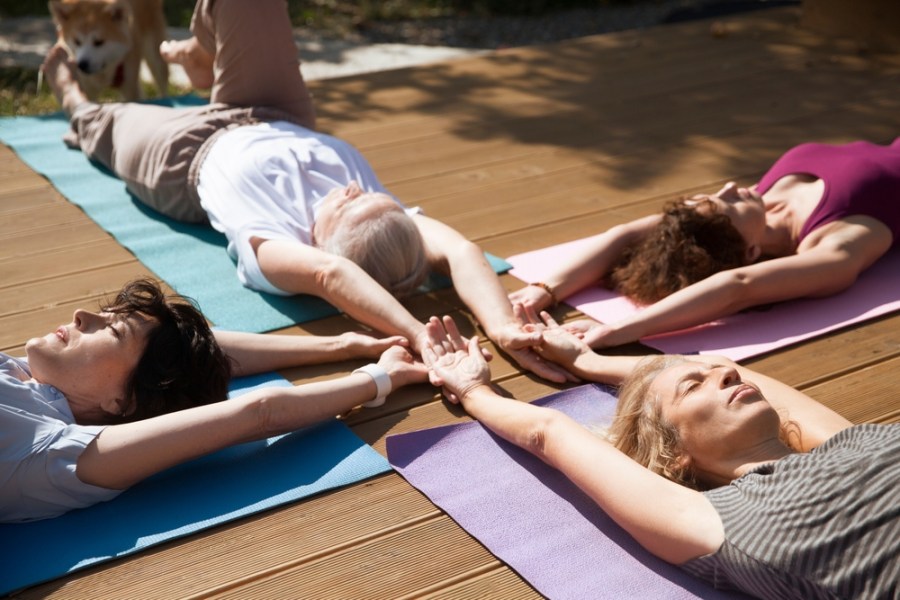
Somatic movement is less about burning calories and more about paying attention to how your body feels. Here’s what to know about its potential benefits, plus three gentle exercises for beginners.
Images: Shutterstock.
You probably know how to work out your muscles and your heart, whether it’s lifting weights, running, yoga, padel, or your other favorite exercise.
But do you know how to work out for your nervous system?
Somatic workouts have been having a moment lately, but if you’re confused about what they can do for you, or you’re unsure how to really reap the benefits, we asked an expert for the full lowdown.
What is a somatic workout?
While it might be called a ‘workout’, somatic workouts don’t follow the traditional sense of the word. You don’t need to go to a gym or use any equipment; in fact, they don’t even require any hard training or repetitions.
‘A somatic workout, or as I would call it, just somatic movement, is, to put it simply: a form of mindful movement,’ explains luxury wellness & mind-body connection expert, Diana Mirs.
It’s essentially a series of slow and gentle, mindful movements that help you focus on internal feelings and sensations rather than outward fitness like building muscle.
‘I would sincerely recommend somatic workouts to anyone, but especially to people who are feeling close to burnout or are experiencing chronic stress, for example, business leaders, entrepreneurs, and executives,’ says Mirs.
‘It is ideal for those suffering from chronic tension in body parts like the neck, shoulders, and lower back; people with constant fatigue who do not feel comfortable with traditional intensive sports; and of course, complete beginners who are either starting or coming back to gentle movement.’
Why should I try a somatic workout?
A somatic workout can not only help your physical health (without putting too much strain on your body) but could also improve your overall sense of wellbeing, and even reduce pain.
‘From my perspective, I can say there are two main benefits of somatic movement,’ says Mirs. ‘On the physical level, it helps to release pain and restrictions in the back, neck, and pelvic floor, improving posture and mobility.
‘On the nervous system level, somatic movement helps to shift the mode of the body from fight or flight to rest and digest. So, simply speaking, it shifts our state from feeling overwhelmed, exhausted, or tired to a regulated and more balanced one. As a result, we can enjoy deeper sleep, reduced levels of anxiety, and a better connection with our mind and body.’
If you’re one of the 20% of people worldwide who experience chronic pain, somatic workouts may even help reduce how much pain you feel.
In a randomized controlled trial of the Alexander Technique for chronic and recurrent back pain, considered one of the earliest forms of somatic practice in the Western world, participants reported about an 86% reduction in the number of days spent in pain compared with a control group, though research remains limited.

How to perform a somatic workout
We asked Diana Mirs for three beginner exercises to practise a somatic workout.
‘The main components of somatic movement are a slow tempo, mindful pauses for self-observation and self-connection, deep breathing, synchronized rhythm, movement, and an absence of rigid limits,’ she says.
1. Add mobility to the chest area
This movement helps you breathe deeper, expand the chest, and add mobility to the area.
- First, take a deep breath in. Next, open your arms, contract the muscles between the shoulder blades, and look slightly up.
- Take a few deep breaths in this position, while engaging your arms and core
- When exhaling, interlace the fingers in front of your body and stretch the back muscles and muscles between the shoulder blades, curving your spine and neck
- Spend a few relaxing moments here, then inhale again, opening the arms, and imagine you want to hug the whole world.
- Then, close the arms again.
- Repeat a few times while moving in a smooth, fluid rhythm with each breath.

2. Engage your pelvic floor and hip area (pelvic clock)
- Start by drawing circles with your hips, drawing them to the right, back, left, and front.
- Repeat.
- Synchronize with the breath for a few cycles, noticing all the sensations inside the belly and pelvic area, relaxing into those moments, and sometimes switching the direction.
‘A lot of emotions are stored in the hip and pelvic area, so stay attentive to what is coming up for you and allow everything to be as it is,’ Mirs notes.
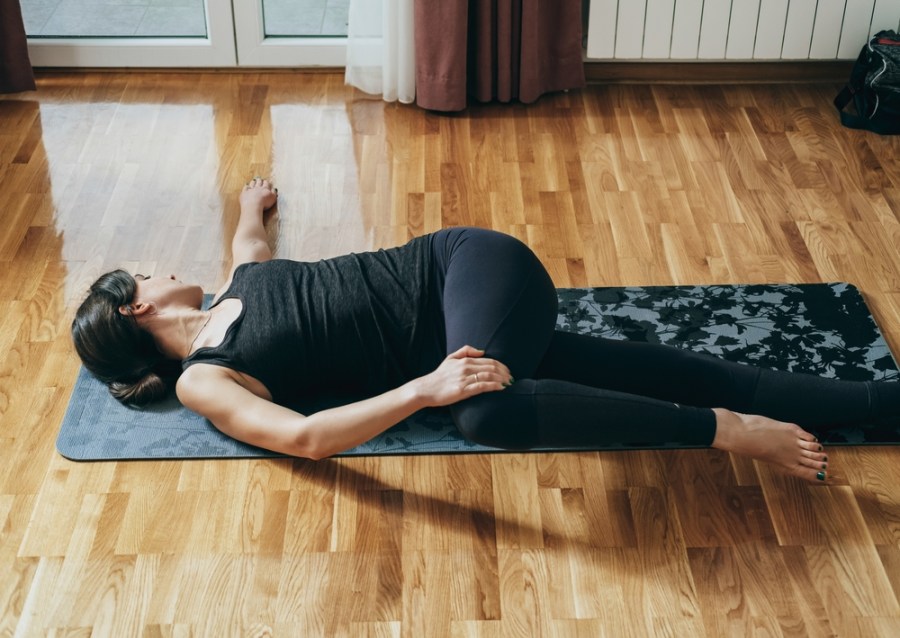
3. Lying down movement to relieve stress
- First, lie down on a mat – or even on your bed, if your mattress is firm.
- Lie straight on your back with your legs bent, knees up, feet on the ground (or mattress).
- Place your hands gently behind your neck, inhale, and twist the knees very gently to one side as you exhale.
- Then, inhale back to the center and exhale to the other side.
- Go slightly deeper each time, ‘but only to the point where it feels like a gentle stretch, not painful.’
‘Again, pay attention to the sensations in the twisting spine, belly, pelvic area, muscles, and inner organs — allowing the release of stress, negative, or unwanted emotions through the movement,’ adds Mirs. ‘Please remember that none of the exercises should be accompanied by any sort of pain, while still encouraging yourself to explore and expand your comfort zone.’
Mirs recommends repeating all the exercises three times slower than you would normally, creating a very comfortable, cozy and relaxing atmosphere for your practice.
‘Do not try to force past your limits, and enjoy long, mindful pauses for about 15 to 30 seconds between each exercise,’ she says. ‘When you learn to move from a state of inner regulation rather than pressure, every aspect of your life and leadership transforms.’
For more ideas on how to perform a somatic workout, try this somatic routine for beginners that takes just 7 minutes:
Diana Mirs is a Luxury Wellness & Mind-Body Connection Expert. Find her at dianamirs.com.