
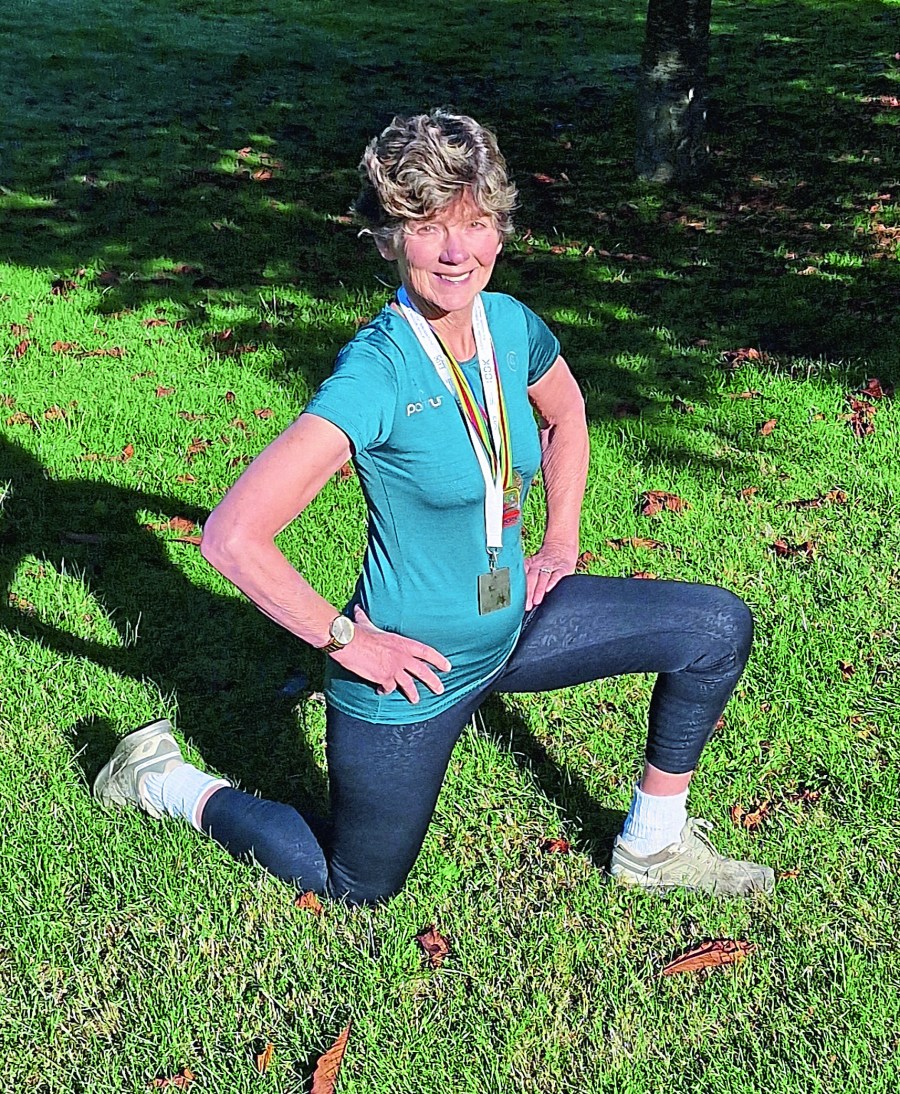
You can reap running benefits at any age, says Dr Louise Dumas, 77, who proves that age is no barrier to enjoying a feelgood race! – whether that’s a 5k parkrun or a triathlon!
Words: Louise Dumas | Images: Shutterstock & Roy Du Preez
How to reap running benefits at any age
Ever noticed how health, fashion and beauty advice usually stops at 68? You might find tips for women into their sixties – but what happens next? Once upon a time, we took up knitting, joined the WI and looked after the grandchildren. There’s nothing wrong with that, but today mature women have plenty of other options. Many of us can still run, compete, and stay fit, strong and healthy into our seventies and beyond.
I’m 77 and have been a runner since 1968, but I’m not an athlete. Strangely, what started me off was reading about Lillie Langtry, mistress of the corpulent King Edward Vll. In order to cope with the king’s 12-course dinners, she ran two miles every morning. When I read about Lillie, I’d just given birth to my first daughter and felt like a meringue. So, I thought I’d give it a try. As everyone finds out, running looks much easier than it actually is. Starting out felt terrible but there was just enough benefit to keep going – although there were no nice trainers, Lycra kit or portable water bottles to make it more comfortable.
Working as a freelance writer allowed me time to run and I never stopped. In the 1990s, I was asked to join the Coakham Bloodhounds as a drag quarry, climbing trees and jumping into muddy rivers to try and lose the hounds – but you never do! I had absolutely no idea what it involved when I was asked to join but those events are some of the most exciting running I’ve ever done.
Next challenge was a running club. I was nervous because I thought everyone would be younger, faster and more athletic than me. But when I joined the Heathfield Road Runners, I realised running with new friends was a wonderful experience.
Age IS no barrier
My first big races were the Beachy Head Marathons, which I ran most years from the 1980s until 2011. Apparently, it’s the second toughest UK marathon (Snowdon takes the top spot) and runners are advised to add an hour to their normal times. But I knew and loved the course and it took me nearly six hours. The London Marathon took me five hours in 2005, when I was almost 60 years old.
After that, I wanted a race I could do every week, so I tried parkrun. It’s a free, timed 5k run on Saturday mornings in local parks around the UK. It became part of my weekly routine, as indeed it does for 350,000 of us in the UK, and more than three million worldwide. For years, I managed a respectable 30 minutes but it’s crept up a little bit to 32-33 minutes today. Fast youngsters flash past me in 17-20 minutes but they’re the age of my grandsons. I usually win my age category of 75-79 years – because I’m the only one in it!
When my husband Roy and I married last October, I moved into his house in Horsham and joined Mel’s Milers, a running group based at Christ’s Hospital School. Roy was a surfer, cricketer and rugby player in his younger days but he says he has hung up all his boots now. He is immensely supportive, often coming to watch parkrun and scoop me off muddy fields. Thankfully, I’ve never had a serious injury. Growing older has slowed me up a little but age brings stamina – and determination. I may be the oldest woman at my new running group, but I’m not the oldest: Colin, 81, runs faster than I do and there are several very quick men in their mid-70s.
In May 2023, I was the proud owner of a new green T-shirt commemorating 250 parkruns and was recently voted parkrunner of the month, which was fantastic. See you at the finish line!
Tips for mature runners
1. Keep going and don’t stop
Starting off is never easy. Even now it takes me a mile to feel comfortable. Wrap up in the winter, strip off in summer, and ignore weather where possible. Rain can be welcome. Alternate between road and off-road surfaces as hard surfaces are tough on joints whereas country/downland trails are softer and kinder on joints, but more difficult to run fast on as they absorb energy. So, it’s good training to alternate between the two.
2. Join a running club
You’ll be surprised how much support other runners will offer you, and how nice it feels to run with a group. All abilities are catered for by many clubs – and most runners are extremely friendly. Coffee and cake are important as well as being welcome treats afterwards.
3. Try parkrun every week
Everyone can have a go at 5k in the local park. You won’t be last – the last person is at home on the sofa! Results are addictive and age-grading offers reward for any achievement. Try parkrun tourism; there’s one everywhere in the UK and many overseas. Competing in parkrun at Zandvlei in South Africa during our world-cruise honeymoon took me through sensational mountain scenery with the Atlantic Ocean alongside.
4. Eat sensibly
My rule has always been 80:20. If you choose nutritious food 80 per cent of the time, you can indulge a bit for 20 per cent. I don’t smoke, but I enjoy a glass of wine, ditto vanilla ice cream, chocolate biscuits and cake. I’ve stayed nearly the same weight of 57kg for more than 50 years.
5. Try other forms of exercise
I belong to a cycling club that rides round the quieter lanes of West Sussex most weeks for 15 to 20 miles – with a coffee-break stop. We’ve become friends, sharing stories – and punctures! I did tackle a few triathlons, between 2005-2010, doing the last when I was 64. These were a demanding 750m swim, 20k bike ride and 5k run but, for one of them, I rode my daughter’s bicycle with the basket still attached to make the point all this wasn’t too serious for me. As an easier alternative, walking briskly is a wonderful form of exercise.
6. Remember, running is fun
Sweat now, smile later. The endorphin rush is like nothing else, although downhill ski racers tell me they get higher, quicker! And if you can’t enjoy a good chat while running, you’re probably running too fast.
9 ways to stay safe when running in the dark
7. Shoes matter
Buy the most expensive, well-designed running shoes you can afford from specialist shops. Runners need shoes to provide support, cushioning and proper fitting: serious damage can be done by lightweight fashion trainers, however decorative. Expect to pay between £75-£150 and to change them every 500 miles. But, as shoes are the only essential specialist kit for running, it’s actually one of the cheapest sports.
8. Use social media
Share stories. Post photos. Pass on running news. Social media plays a part that never existed when I started out in the 1960s and offers real value in communication and contact. My running club also uses a variety of WhatsApp groups.
9. Just do it!
You can run almost anywhere at any time you’re free. Personally, I can’t run up hills anymore and fell running was never my bag. But a woman who won a recent Beachy Head Marathon told me she walked up the Seven Sisters before running as fast as possible down the other sides! Choose a distance to suit you – one mile or 26 miles, 5k or ultra marathons. Achievement is relative. Get running!