


Alice Dogruyol shares her personal health story and how, for most of her life, she’s been trying to lose weight. Here, she asks: does lack of sleep cause weight gain?
Words: Alice Dogruyol | Images: Shutterstock
I have always been a curvy girl who has embraced my voluptuous shape. However, since my late teens I have had a problematic relationship with food. I tend to overeat, comfort eat, and stress eat, which has meant I have perpetually been on some sort of mission to achieve weight loss.
I have been through periods of being fit and strong and in control of my eating but, more often than not, I’ve teetered between being what I call acceptably overweight, where I look and feel good despite carrying 10-15kg extra, and uncomfortably overweight where nothing fits and everything feels wrong – which is where I am currently.
Right now, I’m 120kg and feel uncomfortably overweight (in these pictures I was 90kg). My current weight is 25kg above my normal comfortable curvy weight and 45kg above my goal weight of 75kg, where my BMI would be slap bang in the healthy zone.
Stress-based eating
I know how my recent weight gain happened: it was during the second lockdown, my long-term relationship ended, I put IVF on hold, I was feeling dreadful in every way and I fell into a period of mindless comfort eating coupled with almost no exercise.
Then, in January 2021, I was diagnosed with Type 1 diabetes. Add to that, and as irony would have it, in May 2022 my young, slim, fit and healthy sister, who is only 43 years old, never been overweight, and is a mum to three gorgeous children – was diagnosed with bowel cancer.
As the shock and fear took over my every waking and sleeping moment, I turned to my pain killer of choice: food. And I have been self-medicating with it since.
Thankfully as I write, things are looking up. My sister has responded well to treatment and whilst life will never be quite the same, our family is in a much better place. So much so, a few weeks ago I mustered the courage to dust off my bathroom scales and step on them for the first time in a year and a half. I had an idea of what the number might be, but as it flashed up, it was much higher than expected: 120kg. It was the wake-up call I needed and I snapped into gear; I booked an appointment with my endocrinologist, a session with a new therapist who suggested I attend Overeaters Anonymous – I did and it was brilliant – a session with PT and behaviour analyst Vanessa Haydock aka The Diabetic Health Coach, started Cognitive Behavioural Therapy (CBT), filled my bookshelf with health and fitness books… and looked at my sleeping habits.
The hidden reason women over 40 gain weight: tackle emotional eating for weightloss
Sleep and weight
Our circadian rhythms dictate almost every aspect of our physiology and metabolism, including weight loss. I always notice that if I don’t get enough sleep, I wake up craving carbs and caffeine. I looked into why this might be and found an interesting study that revealed how sleep deprivation can cause hyperphagia, or extreme hunger. The study showed that lack of sleep decreases leptin levels – an appetite-regulating hormone produced by fat cells – and elevates ghrelin – a peptide hormone, produced predominantly in the stomach, that increases appetite!
Lack of sleep also increases stress hormone cortisol, produced by the adrenal glands, and which enhances the production of glucose by the liver and promotes insulin resistance.
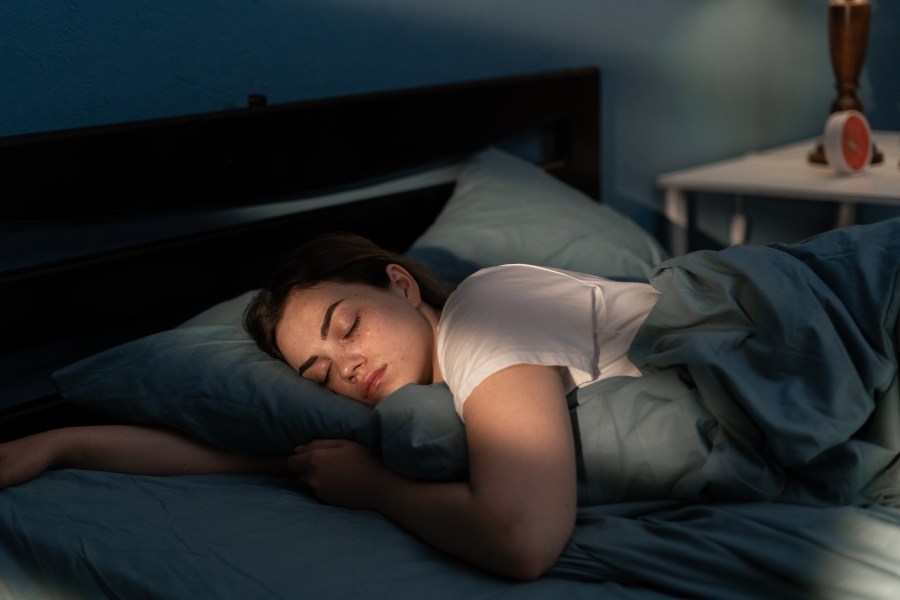
So, there are clear links between sleep and weight. Also, the earlier I go to bed, the less time I spend with my head in the fridge!
Alice’s 5 tips to lose weight while sleeping
1. Eat early in the evening
I often eat my last meal around 6pm; it gives me better blood glucose control through the night, better sleep and helps me lose weight. It can be rather antisocial, though, and can be hard to stick to, but the pay-off is worth it as it helps you burn fat while asleep. Findings published in the Journal of Endocrinology and Metabolism in 2020 showed that blood sugar levels are higher, and the amount of fat burned lower, when eating a late dinner, even when people ate the same meal. The study found that late eaters had peak blood sugar almost 20 per cent higher, plus their fat burning reduced by 10 per cent compared with those who ate earlier. To support weight loss, eat your last meal as early as possible to increase your fasting window and so that your body burns fat rather than glucose as you rest.
2. Curb your carbs
If you eat carbs, do so at the start and middle of the day, not at the end. The body turns carbs into glucose and anything you don’t use up gets stored in fat cells. Research by the Sleep Foundation shows that when you are in REM sleep – when your brain is more active – you use glucose. When you go into deep sleep, growth hormone is released, which helps you build muscle and also lose fat.
3. Build more muscle
When you sleep, your body continues to utilise energy for essential bodily functions such as breathing, temperature regulation and cell growth and repair. The energy you use to just keep going is called your basal metabolic rate (BMR) and accounts for about 80 per cent of your total energy used in a day.
People with more muscle have a higher BMR and burn more calories. As a rule, the more muscle and less fat you have, the faster your metabolic rate. Exercising and building muscle is one way to improve your BMR. The biggest muscle in your body is your quads, so it makes sense to build those. I use a TRX strap that hooks over the door to help me do squats. Muscles also like using glucose, which is great for diabetes control.
4. Cut your caffeine intake
Some people can metabolise caffeine quickly, some can’t. There is growing evidence to suggest that genetic factors play a role. This would explain why some people can have six coffees a day or a coffee in the evening and have no problems falling asleep. I know that I metabolise coffee slowly and an after-dinner coffee would keep me up until 3am. For me as a Type 1, it also causes a little glucose spike. My best sleep comes, sadly, when I cut coffee and caffeine out of my diet completely.
5. Increase your deep sleep
As you sleep, you produce human growth hormone (HGH). This important hormone is involved in many biological processes including being the main driver of cell repair, muscle growth and fat metabolism. It enhances the utilisation of fat by stimulating triglyceride breakdown and oxidation in adipocytes (fat cells). You release most growth hormone when in deep sleep, which you cycle in and out of throughout the night. Going to bed as early as you can before midnight means you’re likely to get more deep sleep than if you went to bed at midnight but slept in in the morning.
I use the sleep app ShutEye to track my sleep phases and my time in deep sleep, which is sometimes alarmingly low, but Type 1 diabetes can really throw some curve balls in the night and mess with your sleep. I keep a bottle of Life Armour Drops of Slumber+ (£25, lifearmour.co.uk) next to my bed. It contains ziziphus, valerian root and vitamin B6, which help regulate levels of sleep hormone melatonin. What’s more, it doesn’t make you drowsy in the morning.