
Perimenopause can change your relationship with exercise, but you don’t have to abandon your training goals. Here’s how Pilates could help you build a more balanced routine.
Images: Shutterstock.
The changes that come along with perimenopause and menopause can be all-encompassing. It’s not just an end to periods, and for many it isn’t a walk in the park. In fact, an estimated 80% to 90% of women in the US experience problematic symptoms once they reach menopause.
One issue that many women experience is a group of symptoms known as Musculoskeletal Syndrome of Menopause, or MCM. This includes joint pain and stiffness, muscle pain and weakness, tendon and ligament issues, a reduction in flexibility, reduced bone density, and more.
This can leave many women feeling achy, uncomfortable, and less strong than before.
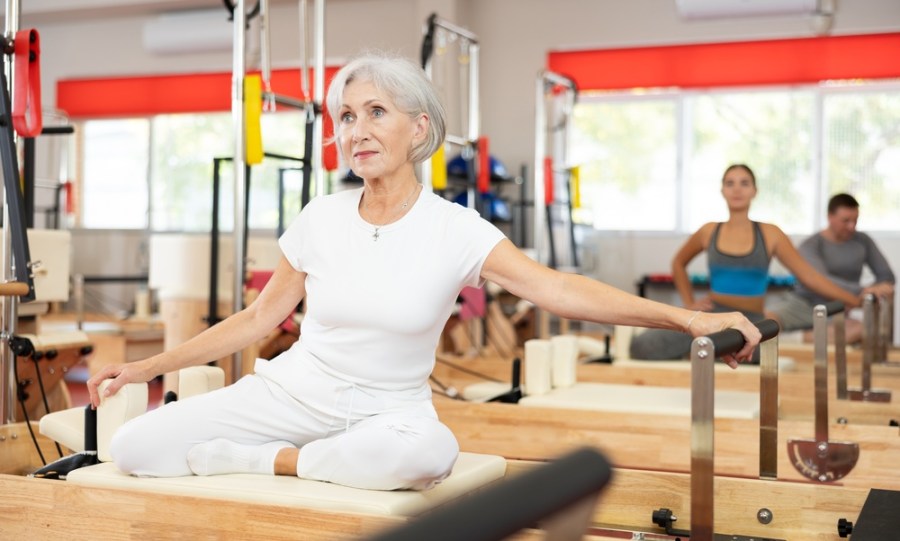
Importantly, one of the best things you can do to alleviate the symptoms of MCM is to exercise. But not all exercise is created equal, which is why Pilates expert Korin Nolan is on a mission to highlight the essential role that Pilates can play in your perimenopause training routine.
‘As estrogen declines, bone and muscle loss accelerate,’ says Pilates expert Korin Nolan, ‘Progressive resistance training helps preserve and build muscle, supports bone health and keeps everyday activities like carrying shopping, climbing stairs or getting up from the floor feel doable.’
Nolan recommends incorporating a well-rounded movement practice to help you navigate this period of life with strength and comfort.
Why is Pilates so great for training in Perimenopause?
Even if you’ve never done Pilates before, you can reap the benefits of adding it into your routine.
‘Pilates is a great place to start for a beginner as it does offer moderate resistance and encourages good movement patterns and technique, so that when you come to adding heavier loads, you’re more competent,’ says Nolan.
‘Pilates brings controlled movement, coordination and strength around the hips and trunk into the mix, making it a complementary practice to resistance training.’
She outlined eight of the major benefits of Pilates during menopause below.
1. Keeps your joints moving
‘Changes in estrogen can contribute to increased joint stiffness and changes in connective tissue,’ says Nolan, advising that the controlled movements of Pilates help build strength but also, crucially, help add mobility back.
2. Helps with core strength
Core strength and trunk stability are often overlooked in workouts as we age, but they’re key as they support the spine, improve movement mechanics, and give us a strong foundation. ‘A strong core is about far more than having visible abs,’ Nolan adds.
3. Helps with balance and stability
‘Changes in muscle strength, reaction time, vision, and sensory feedback can make it harder to react quickly when losing balance,’ says Nolan, highlighting the importance of balance and proprioception (the ability to know where your body is in space). Balance is particularly important as studies show falls become increasingly difficult to recover from as we age.
4. Complements heavy strength training
‘Maintaining muscle and bone mass becomes vital from perimenopause onwards,’ Nolan says. However, ‘while Pilates builds muscular endurance and strength, it should complement—not replace—progressive strength training with sufficiently heavy loads.’
5. Supports pelvic floor awareness
Similar to working out your core, Pilates can encourage ‘coordination between the breath, deep abdominal muscles, and the pelvic floor.’ This can help women experiencing urinary leakage as they age, helping to develop greater awareness and control.
6. Supports breathing and relaxation
Perimenopause not only affects the body, but also the mind. The deliberate breathing and concentration practised as part of a Pilates routine can help release tension and foster a sense of calm, helping during periods of stress, poor sleep, or overwhelm.
7. Improves the quality of strength training.
‘Good strength training requires control, alignment, mobility, and body awareness. Pilates develops all of these, making it an exceptional partner to lifting heavier weights,’ says Nolan.
8. Helps build intensity with minimal impact
Impact can become more difficult as we age and into menopause, due to the potential increase of joint problems. Pilates is predominantly low-impact, says Nolan, ‘allowing you to challenge your muscles without repeatedly loading the joints through jumping.’
‘Low impact does not mean low intensity—a well-programmed session can be seriously challenging,’ she adds.
How to get started
Pilates can provide an excellent foundation for women of all exercise levels, but can be particularly useful for those new to exercise or who have previously reduced their movement due to menopause symptoms.
‘I would recommend two to three Pilates sessions a week, around 20-45 minutes each, depending on your starting point and schedule,’ advises Nolan, ‘…A beginner could start with two sessions of 15-20 minutes and gradually build up. Consistency matters more than completing a long session occasionally.’
Nolan recommends combining Pilates with strength training on at least two days a week, plus a regular cardiovascular activity like brisk walking, cycling or swimming, for great all-around fitness.
‘Think of Pilates as the foundation to support any other training you do or sports you enjoy.’
Korin Nolan is a leading Pilates expert and self-proclaimed health and wellness junkie. Find her at korinnolan.co.uk or on Instagram @KorinNolanPilates