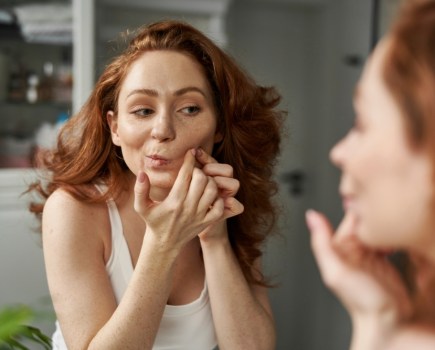


Many women assume their best sex is behind them once they hit 50. But relationship and sex therapist Becky Crepsley-Fox says the opposite can be true
While menopause can bring challenges such as vaginal dryness, a lower libido and changes in sensitivity, it can also be an opportunity to rediscover what really works for you. With fewer worries about pregnancy, greater confidence and a better understanding of your body, many women find that with a few tweaks, intimacy becomes more satisfying than ever.
Here are my top ten tips for achieving a satisfying sex life
1. Broaden your definition of sex
Sex isn’t just foreplay followed by penetration – that’s one version, and frankly quite a narrow minded one. Sex can be oral and nothing else. It can be a massage with a proper snog. It can be spanking with masturbation. Ask yourself: does sex become more appealing when it’s no longer centred around the traditional male script? For many women, the answer is a resounding yes.
2. Make foreplay your main play
For most women, foreplay has always been where the magic happens – and at this stage of life, it deserves to be the main act. As oestrogen dips, the vaginal walls become thinner and more delicate, so warming up properly isn’t a nice-to-have, it’s the headline act. Slow everything right down, linger longer, and if penetration doesn’t appeal? Skip it altogether.
3. Be generous with lubrication
Natural lubrication declines around this age, and the single easiest upgrade to your sex life is to use far more lube than you think you need. Quality matters here too: shifting hormones change the vagina’s pH, which can leave you more prone to UTIs and thrush – so skip the high street lubes packed with glycerine and perfume. Choose a well-formulated, pH-friendly option such as the YES® organic range, so you’re supporting your body rather than working against it. Silicone-based lubes are long-lasting and condom-safe – just don’t pair them with silicone sex toys, as they can damage the surface. If toys and condoms are both in the mix, water-based lube is the happy all-rounder. There’s no prize for going without, so pour liberally.
4. Bring sex toys into partnered sex
Keeping continued pressure and stimulation on the clitoris during penetration – with fingers, a vibrator or a pulsator – is a game-changer. The clitoris contains over 10,000 nerve fibres and is the body’s most sensitive erogenous zone – the only organ that exists purely for pleasure – so as sensation elsewhere softens over time, it makes sense to focus attention there. Work smarter, not harder.
5. Use a longer runway to your advantage
If orgasm takes longer to arrive these days, reframe it: you now have more time to focus on exactly what you want in the moment. Tune in and ask yourself – is it a consistent stroke, over and over? Being flipped over and changing things up entirely? Rather than rushing through habitual sex on muscle memory, use the extra time to actually savour sensation. Slow sex is not lesser sex.
6. Masturbate often
Here’s a genuinely joyful prescription: regular masturbation keeps blood flowing to the vulva and vagina, which helps keep the tissue healthy and can ease symptoms of ‘vaginal atrophy’. Let the clitoris take centre stage, but where possible, involve the vagina too, as internal stimulation helps keep those tissues supple and well-supplied with blood. A dildo inside the vagina while a vibrator works on the clitoris is a particularly winning combination.
7. Do your Kegels daily
Strengthening the pelvic floor muscles around the vulva can genuinely increase pleasure. Not sure which muscles we’re talking about? They’re the ones you’d use to stop the flow of urine mid-stream. Locate them once, then do your actual practice anywhere but the toilet – repeatedly stopping urine mid-flow can increase your risk of a UTI, and nobody’s sex life is improved by one of those. Try 10 engagements a day with your breath: exhale to engage, inhale to fully relax, and build up from there. The relaxing part matters just as much as the squeezing – the goal is a responsive pelvic floor, not one held in permanent tension.
8. Connect with your body outside the bedroom
Training your attention now pays off later. Set aside five minutes a day to slowly stroke your body, and every time your mind wanders – which it will, constantly – gently bring it back to the sensation. This simple practice builds your ability to stay present with pleasure, and it’s especially useful at a life stage when shifting hormones can crank up anxiety. The skill transfers directly: when your mind jumps around during sex, you’ll know how to bring it back.
9. Get curious about what you really want
If desire is quieter than it used to be, treat it as an invitation to investigate rather than a verdict. In my practice, this is often the question that unlocks everything: what would genuinely entice you – not what’s supposed to, but what actually does? Is there a kink you’ve never voiced? A type of sex you’ve always been curious about but never tried? Consider which senses draw you into sex. If you’re led by physical sensation, playing with textures – a feather, a silk scarf trailed across the skin – might be your route in. If desire lives in your mind, spending time with a fantasy before or during sex could be the key. And if you’re connection-based, ask yourself what you need in the lead-up to feel genuinely close to your partner – because for you, that closeness is the aphrodisiac. Midlife is a brilliant moment to stop performing desire and start following it.
10. Talk to your partner
A changing body means changing sexual function – and that’s a genuinely good window to open up the conversation about what you do and don’t enjoy. Be honest, be specific, and remember: you’re not going to want sex if it’s not the kind of sex you actually want to be having. Speaking up isn’t a complaint, it’s an act of optimism about what your sex life could become.
For more information about Becky Crepsley-Fox and her services, visit beckycrepsleyfox.com